What Happens Between Your Idea and 100 Finished Hats
Every custom hat order waits twice — seven days for a sample, fifteen for bulk — with a handful of decisions in between. Here is the whole path, stage by stage, and the four things that move the dates.
Every custom hat order waits twice, and the two waits are not the same wait. The first is the sample: seven days from a confirmed specification, because a physical hat has to exist before anyone can approve a shape. The second is bulk: fifteen days from the day you approve that sample.
Everything else in the brief — artwork, colour, packing, destination — decides whether those two dates hold or slip. This is the whole path, and the four things that move it.
What to send with the first message
You do not need a technical pack. You need six answers, and any of them can be a photo:
- Quantity. Our production minimum is 100 pieces per style — a production minimum, not a sample fee dressed up as one.
- The hat. A photo of a cap you like, or a name from our range: baseball, trucker, dad hat, bucket, beanie, visor, sun hat.
- Fabric and colour. A Pantone reference if you have one; a swatch photograph is enough to start.
- The logo file, vector ideally and a sharp image at minimum, plus where it goes on the hat.
- Packing. A polybag on its own, or a woven label, a hangtag, an inner box.
- The date you need it. A date rather than “as soon as possible”, because it decides whether the run is comfortable or tight.
Those six are enough to answer with a price and a sampling date, in one reply.
What the sample actually settles
A sample is not a formality before the real order. It is where five decisions stop being words and become a hat you can put on a table:
- Panel count and profile. A 5-panel and a 6-panel are two different hats, not two versions of one.
- Brim length and curve, which is the difference between a cap that reads workwear and one that reads streetwear.
- Fabric hand. Cotton twill against canvas against brushed cotton is a decision you can only make by touching.
- Embroidery size and placement, and whether 3D puff adds height or just weight. Fine detail disappears into rib knit; it does not on twill.
- Closure and inside finish — snapback, buckle, strap, and what the customer sees when they turn it over.
Change one of those after approval and the pattern changes with it, which puts you back into sampling. That is the single most common way a run loses a fortnight.
After approval: seven stages under one roof
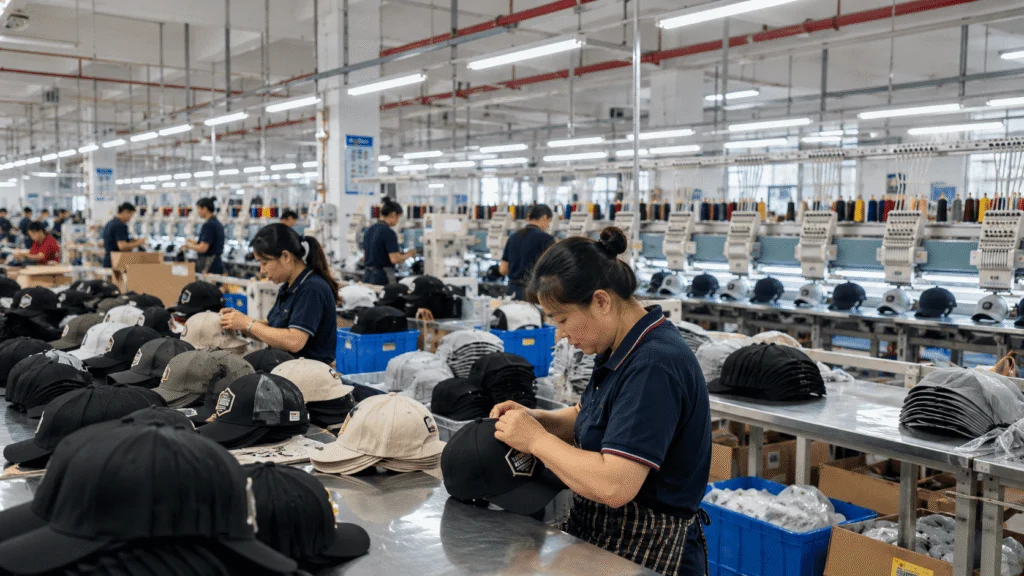
Bulk runs here come off our own plant in China — five production lines, about 120 people on the floor, 20,000 caps a day across the five. That is why the answer to a question during production comes off the floor instead of being forwarded to a third party.
| Stage | What happens | What it decides |
|---|---|---|
| 1. Materials & cutting | Fabric is checked against the swatch you approved, then cut in stacks | Whether every panel in the run comes from the same piece |
| 2. Panel sewing | The panels of one crown are joined along their seams | Whether the shape sits straight |
| 3. Brim & crown shaping | Brim and crown are formed and held | Whether the cap keeps its curve instead of flattening in the carton |
| 4. Logo application | Embroidery, print or a sewn patch goes on | Size and placement, measured against the approved sample |
| 5. Pressing & finishing | Pressed, threads trimmed, shape set one last time | How the hat reads when the customer takes it out of the bag |
| 6. Inspection | Stitching, logo, measurements and hardware are checked | Whether the run matches the sample you held, not an average of it |
| 7. Packing | Counted into polybags and cartons with the shipping marks agreed | Whether the number in the carton matches the order |
What moves the dates
- A fabric that has to be dyed to a Pantone rather than taken from stock — the days go before the line starts, not during it.
- A decoration with several passes: puff, then print, then a patch on top, each waiting for the one before.
- Artwork that arrives after the sample is approved. The hat is ready and the logo file is not.
- A change after approval, of almost anything structural, because it sends the pattern back to the table.
None of that is unusual, and none of it belongs in a surprise. When a date is tight, the quote says which stage will make it tight, at the point you are deciding rather than three weeks later.
Where to start
A photo and a quantity is enough to tell you what a run costs and when it can be made. Send the design and the reply carries a price, a sampling date, and — if something in your brief will move it — the sentence that says so.